Educational material from
What you will learn
- Agree on equal conditions before participants see the result.
- Calculate percentage changes without confusing different starting amounts.
- Evaluate decisions and uncertainty even when someone has the highest value.
Write a rule sheet everyone accepts
Begin with the same starting amount of SEK 10,000 in virtual money and agree on the available choices. In this paper version, there are only company A, company B and cash. Every participant allocates the whole amount before the scenarios. Cash is unchanged, no new deposits are allowed and nobody trades midway through the task.
Also agree on a start and finish if you later compare over an actual time period. State when the value will be observed, which currency is used and how fees or dividends are handled. This simplified paper activity leaves out fees, tax, dividends and currency effects. That assumption belongs on the rule sheet, rather than being discovered when a winner is announced.
- The same starting amount and allowed choices for everyone.
- A fixed allocation, written before the scenarios are shown.
- No real money, prices or promises of future returns in this task.
- Report both the ending value and a short explanation.
Write your reasoning before the outcome
Write three sentences beside your allocation: Why did I choose these weights? Which change could affect my portfolio most? What information am I missing? Writing before the result lets you distinguish the original thought from an explanation added afterwards.
You do not need to find a real company to make this comparison. Two fictional holdings make allocation easier to follow. If you investigate real companies in a later learning activity, state company facts and sources separately from assumptions about future prices.
Compare two allocations in the same scenario
Alex puts SEK 7,000 in A, SEK 1,000 in B and SEK 2,000 in cash. Sam puts SEK 3,000 in A, SEK 5,000 in B and SEK 2,000 in cash. In the first scenario, A rises 10 percent while B falls 20 percent. Alex gets 7,700 + 800 + 2,000 = SEK 10,500. Sam gets 3,300 + 4,000 + 2,000 = SEK 9,300.
Alex's change is +5 percent and Sam's −7 percent from the same SEK 10,000 starting value. In this scenario, Alex has the higher ending value. That shows how the chosen weights interacted with these particular price changes. It does not prove Alex can predict future prices or that the same allocation always produces the highest value.
If the table does not fit, scroll it sideways.
| Participant | Ending value | Change |
|---|---|---|
| Alex | SEK 10,500 | +5 % |
| Sam | SEK 9,300 | −7 % |
Make the review useful for whoever finished lower
First read the reasoning written at the start. Which assumption did the scenario support? Which did it not? Ask each other to show the calculation in kronor before discussing the percentage. Then create a new scenario from the same starting allocation: A falls 20 percent and B rises 10 percent. The question is now how sensitive the comparison is to a different event.
Distinguish a correct calculation from well-supported decision-making. Recognise a clear source, a stated assumption or a discovered calculation error even when the ending value is lower. Do not use stakes or prizes requiring real money in the activity; focus on what each participant can explain afterwards.
Connect the activity to Investiq's described experience
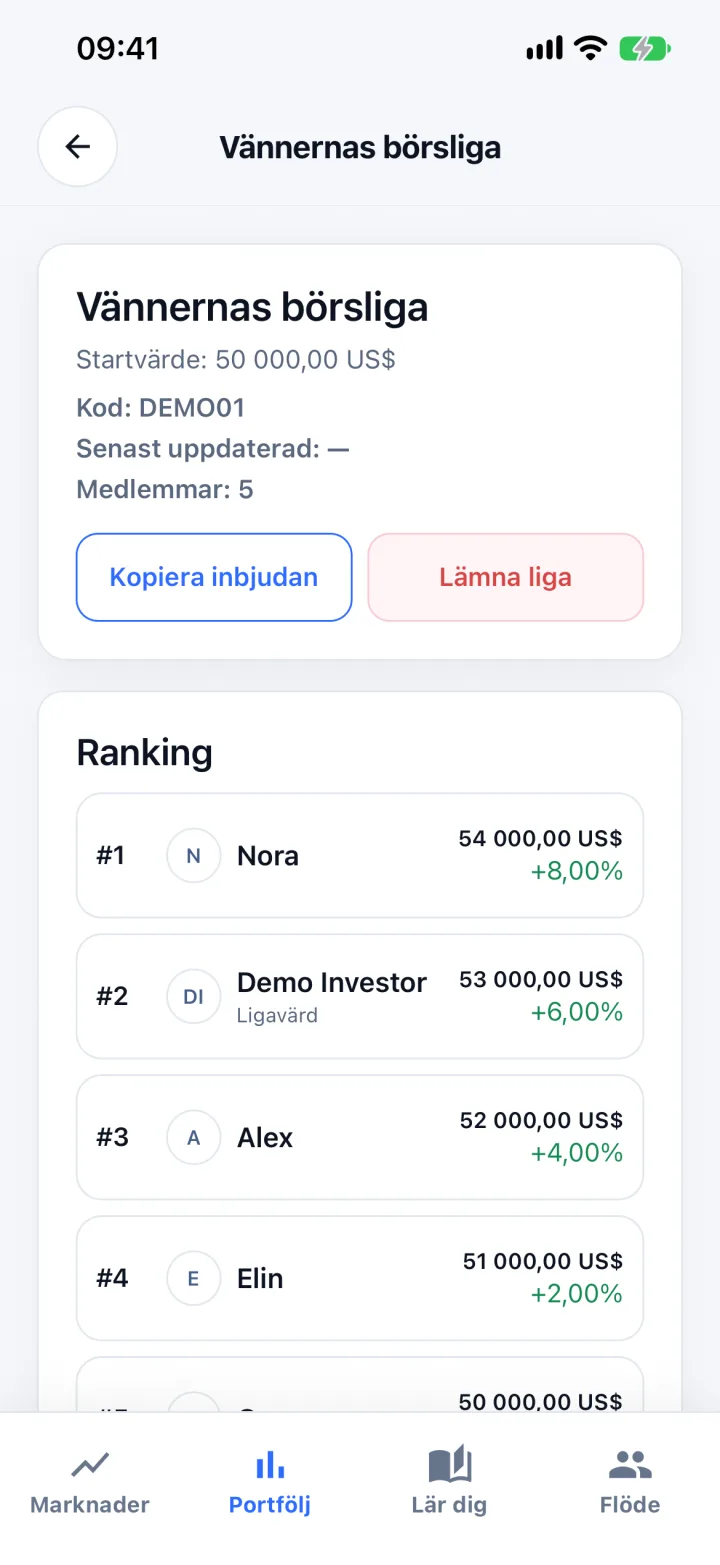
Investiq's product guide describes virtual portfolios and challenges with friends ahead of launch. It also explains which screenshots come from the development version. The rule sheet on this page is an independent learning plan; it does not describe settings you can assume exist in the app.
Continue by reading the product guide's section about comparing and learning together, and check current launch information. A simulated result needs to be interpreted under the conditions used in the activity. It does not tell you what result the same decisions would produce with real money.
Try it yourself
Restart from Alex and Sam's starting allocations. A now falls 20 percent and B rises 10 percent. Calculate both ending values and percentage changes. Who has the higher ending value in this alternative scenario?
Show the solution and explanation
Alex finishes with SEK 8,700 (−13 %). Sam finishes with SEK 9,900 (−1 %). Sam has the higher ending value here.
Alex: 7,000 × 0.80 + 1,000 × 1.10 + 2,000 = 8,700. Sam: 3,000 × 0.80 + 5,000 × 1.10 + 2,000 = 9,900. Different price movements change the outcome despite unchanged starting weights.
Check your understanding
Can an extra deposit look like a good result?
Yes. A higher ending value can come from money being added. That is why this task allows no deposits and uses the same starting amount.
Does a win prove the decision was better supported?
No. Read the reasoning and assumptions from before the outcome. One scenario cannot reliably distinguish skill from luck.
Practise with virtual money
Try what you just learned in a practice portfolio with virtual money. You don't deposit any real money.
How the practice portfolio worksKeep learning and practising
More activities on this topic
Start and learn together
Sources and examples
The sources support the factual explanations. Calculations and exercises were created for this lesson. Amounts and price changes are invented unless stated otherwise.
This material is educational and does not recommend securities to buy. A simulated result does not guarantee a future result.